
Meet postdoctoral fellow, Dr. Guanjie Lyu
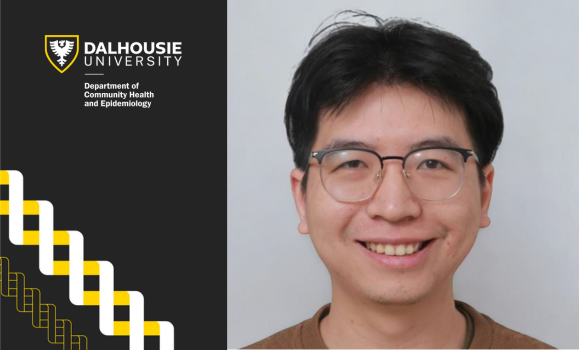
Dr. Guanjie Lyu is a Postdoctoral Fellow in the Department of Community Health & Epidemiology working under the supervision of Dr. Cindy Feng. His research sits at the interface of methodological statistics and applied public health, with a focus on mental health and substance use–related emergency department care.
Q: What drew you from a PhD in statistics to community health and epidemiology?
I completed my PhD in statistics at the University of Windsor, focusing on dependence modelling, copula methods, and nonparametric estimation. During my doctoral work, I became increasingly interested in applying advanced statistical methods to real-world health problems, especially questions around health service use and health equity. That curiosity led me to pursue postdoctoral research in community health & epidemiology at Dalhousie University, where I now work at the intersection of methodological statistics and applied public health, using quantitative tools to answer questions that matter for patients, clinicians, and policymakers.
Q: How does your statistical training shape the way you approach public health questions?
My training in statistics gives me a strong foundation in probability, inference, and modern regression methods. I tend to start from the data-generating process: What mechanisms are plausible? Where might bias enter? How can we account for complex dependence, zero inflation, or nonlinearity? Because of this background, I gravitate toward methods that explicitly handle real-world complexities—such as endogeneity, spatial clustering, and semicontinuous outcomes—rather than forcing data into overly simple models. At the same time, my exposure to community health and epidemiology keeps me grounded in clinical relevance and interpretability, ensuring that the models I build can inform practice and policy.
Q: Can you share a project that addresses a community-identified need or structural determinant of health?
One ongoing project I’m working on examines emergency department (ED) length of stay and 30-day readmission among patients presenting with mental health and substance use concerns in Nova Scotia. Clinicians and health system leaders have identified prolonged ED stays and frequent revisits as key challenges, especially for vulnerable populations. In this project, I jointly model ED length of stay and the probability of 30-day readmission, while incorporating neighborhood-level socioeconomic indices and community cluster information. This approach allows me to quantify how social deprivation, local service environments, and hospital-level factors jointly influence care pathways. The goal is to inform targeted interventions—such as enhanced follow-up, crisis stabilization options, or community supports—in areas and patient groups with the greatest unmet needs.
Q: How do you ensure your findings reach policymakers, clinicians, and communities?
I try to make every project immediately usable, not just publishable. As results come in, I turn them into short, plain-language one-pagers, simple graphs, and slide decks that can be taken straight into decision-making meetings.
Q: What mentorship experiences have shaped you, and how do you support trainees?
As a mentee, working with my PhD supervisor, Dr. Mohamed Belalia and now, Dr. Cindy Feng has been formative. They encouraged me to think critically about both the statistical rigor and the real-world implications of my work. As a mentor, I have co-supervised and supported graduate and undergraduate students in statistical programming, data analysis, and project writing. Helping trainees move from abstract theory to applied health data has been especially rewarding, and it has reinforced my commitment to clear communication and reproducible research practices.
Q: Where is your work headed next, and what impact do you hope it has?
In the long term, I aim to build a research program that combines advanced statistical methodology with policy-relevant applications in mental health and substance use care. Methodologically, I plan to further develop joint and dynamic dependence models that can handle complex data structures, such as longitudinal ED trajectories, spatial clustering, and changing care pathways over time. I hope my work will influence public health practice and policy in the Maritimes and beyond by clarifying how system and social factors interact to drive outcomes and where targeted interventions can have the greatest effect.