
Meet researcher, Dr. Michelle Dimitris
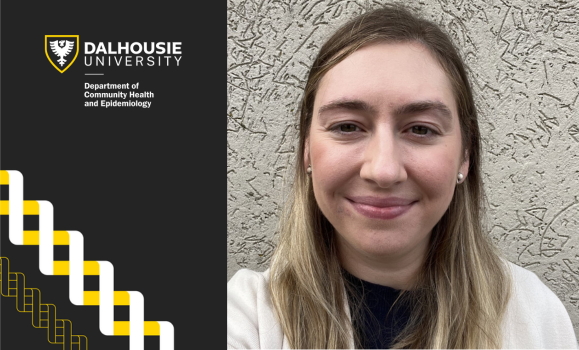
Dr. Michelle Dimitris joined Dalhousie University’s Department of Community Health & Epidemiology in January 2024 as an assistant professor, bringing with her a deep commitment to advancing pregnancy and child health through methodologically rigorous research and teaching. Her academic journey—from Queen’s University to McGill University—has equipped her with a strong foundation in epidemiology and advanced quantitative methods, shaping her approach to some of the most complex questions in pregnancy health.
Dr. Dimitris’ research centers on perinatal epidemiology, with a particular focus on the early stages of pregnancy. This period, often overlooked in large-scale studies, presents unique methodological challenges that she is determined to address. Her current work explores early prenatal care, aiming to improve understanding and inform public health policy in Canada. Beyond research, Dr. Dimitris is passionate about teaching and mentoring, helping students develop the skills and critical thinking needed to tackle real-world health challenges.
Her career reflects a blend of intellectual curiosity, technical expertise, and a human-centered approach. Whether designing data collection strategies, applying advanced causal inference methods, or finding creative ways to make epidemiology relatable, Dr. Dimitris exemplifies the role of a scholar who bridges theory and practice. She believes that humility and trust are essential in collaborations.
Q: What inspired your career in epidemiology, and how did your academic journey shape your research focus?
My interest in epidemiology began during my master’s training at Queen’s University, where I gained a strong foundation in core concepts. Later, at McGill University, I specialized in advanced epidemiological methods, including methods useful for inferring causality. These experiences shaped my approach to research and gave me a wide range of tools to tackle complex questions in perinatal epidemiology. I am deeply grateful for the comprehensive education I received—it continues to influence how I design studies and interpret data today.
Q: Your research focuses on perinatal epidemiology both locally and globally. What are the key questions driving your work, and what challenges do you face?
I am particularly interested in research questions related to pregnancy and child health that have global implications. One of my current areas of focus is the early pregnancy period, which is notoriously difficult to study using existing data infrastructure. For example, early pregnancy loss is often incompletely captured in administrative or pregnancy databases, making it methodologically challenging to analyze. Additional data collection may be necessary, but determining how and among whom to collect these data requires careful consideration. These challenges motivate me to explore innovative approaches to improve the quality and completeness of research in this area.
Q: How did your interest in advanced quantitative methods and causal inference evolve, and how do these tools enhance your research?
My interest in advanced methods began during my master’s program and deepened while working as a data analyst at the Centre for Global Child Health at the Hospital for Sick Children. Being involved in the early stages of projects—designing data collection tools and strategies—sparked my fascination with study design and the mechanics of data organization. This experience led me to focus on advanced epidemiological methods during my PhD.
These tools are critical for understanding complex relationships in perinatal health. For instance, causal mediation analysis helps uncover mechanisms behind observed associations. In one study, I examined how mid-pregnancy weight gain mediated the relationship between twin pregnancy and gestational diabetes among pregnancies with normal or overweight pre-pregnancy body mass index. Similarly, flexible extensions of Cox proportional hazards models allow us to study time-varying exposures, such as weight gain, and their impact on gestational age at delivery. These methods provide nuanced insights that traditional approaches might miss.
Q: How do you integrate research into your teaching, and what skills do you hope students gain?
My research and teaching are deeply interconnected. Epidemiological methods—the backbone of my research—are central to my course content. I aim to help students recognize methodological challenges, understand their potential impact, and consider strategies to address them. Beyond technical skills, I hope students develop the ability to identify epidemiological concepts in everyday life, even outside the classroom. This broader perspective fosters critical thinking and prepares students to apply epidemiological principles in a wide range of contexts.
Q: What do you enjoy most about teaching?
Teaching energizes me. I love seeing students connect the dots and gain confidence in their understanding. Their questions often push me to think more deeply about concepts, which makes the learning experience mutual. Interacting with students reminds me why I chose this career—it’s an opportunity to inspire and be inspired.
Q: What’s something people might not know about your approach to research?
I enjoy making connections between epidemiological concepts and sports or popular culture. These analogies provide relatable examples that make complex ideas more digestible for students. It’s a fun way to bridge theory and practice while keeping learning engaging.