
Meet postdoctoral fellow, Dr. Abouzar Choubineh
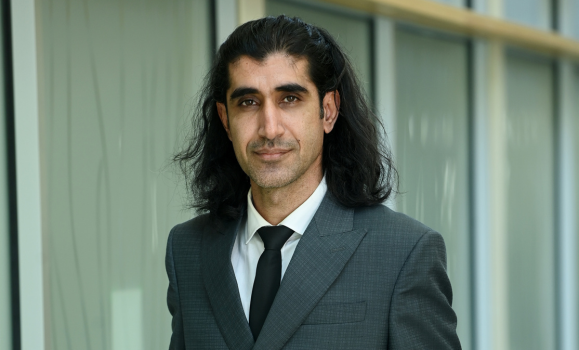
Dr. Abouzar Choubineh is a postdoctoral fellow in the Department of Community Health and Epidemiology, a position he has held since May 2024. Leveraging a computer science background, he applies data science, artificial intelligence (AI), and bioinformatics to address health challenges—contributing to the department’s mission of advancing public health through research, education, and community engagement.
Q: What is your current research focus?
I am motivated by the opportunity to apply machine learning and deep learning to complex, real-world health challenges. By bringing advanced AI methods to medical and epidemiological data, I aim to improve our understanding of health outcomes and to support data-driven, physics-informed public health interventions.
Q: What is your academic background?
I earned a BSc in petroleum engineering from Shiraz University in Iran (2008-2012), followed by an MSc in petroleum engineering at the Petroleum University of Technology, also in Iran (2013-2015). I then completed a PhD in computer science at the University of Liverpool in the UK (2020-2023).
Q: Who are you collaborating with at Dalhousie?
I work with Dr. Samina Abidi in the Department of Community Health and Epidemiology.
Q: What are your primary research interests?
My primary research interests span data science, artificial intelligence, bioinformatics, and energy. In health contexts, I am particularly interested in developing methods and frameworks that integrate machine learning and deep learning with domain knowledge, enabling the creation of models that are practical, generalizable, and interpretable.
Q: What are you working on currently?
I am currently working on several projects that leverage AI for medical and population health research. These include developing prediction modeling frameworks to address inherent challenges in population health datasets related to cancer, generalizing AI pipelines across diverse medical datasets, analyzing longitudinal changes in health features linked to cancer outcomes using causal inference, and exploring the application of physics-informed neural networks in medicine.
Q: How do you see your work contributing to the department’s mission?
By developing robust AI models and translating findings into accessible insights, I aim to support research excellence, enhance educational initiatives, and contribute evidence that can inform community-engaged public health practice.