
Meet researcher, Dr. Sanja Stanojevic
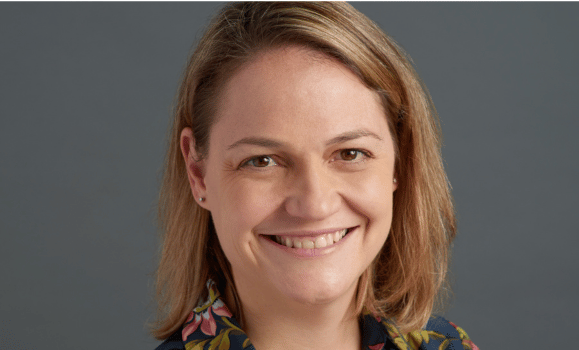
Dr. Sanja Stanojevic is an associate professor in the Department of Community Health and Epidemiology at Dalhousie University and a leading respiratory epidemiologist whose work has reshaped how clinicians diagnose and manage lung disease across the lifespan. Grounded in clinical epidemiology and powered by data, her program investigates how the lungs grow and age, and how exposures at different points in life influence the development of lung conditions. At the heart of this work is a commitment to building practical, evidence‑based tools that put patients on the right diagnostic and treatment path—early.
A defining contribution of Dr. Stanojevic’s career is the development of lung function growth charts, now used around the world to interpret pulmonary measurements . By tracking lung growth and changes with age, these charts help clinicians identify early signals of risk and intervene before disease becomes advanced. Her team’s methods, rooted in secondary data analysis , have advanced both research and routine care.
Beyond her research, Dr. Stanojevic is a respected leader and advocate. She chairs the American Thoracic Society’s Pulmonary Function Committee, serves as director of the European Respiratory Society’s Clinical Research Collaboration Network, and has led multiple task forces that produced technical standards widely adopted internationally. During the COVID‑19 pandemic, she chaired a Canadian Thoracic Society working group that guided aerosol precautions for lung function testing and helped secure appropriate PPE for healthcare professionals. In Atlantic Canada, she collaborates with provincial lung association to expand access to diagnostic testing and raise awareness of lung health, reflecting an enduring commitment to equitable care. In recognition of her impact, the Canadian Lung Association named her among the recipients of the King Charles III Coronation Medal—a distinction she credits to the “amazing teams” she works with in Halifax and around the world.
Q: What is the main focus of your research program?
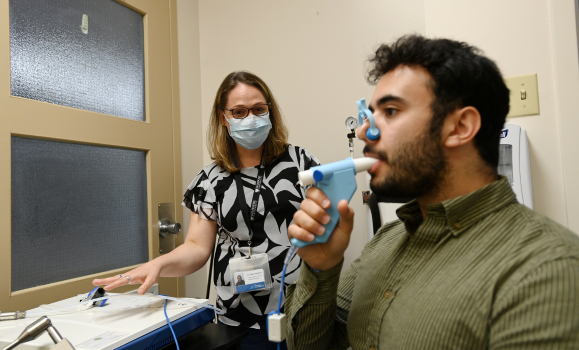
My research team studies how lungs grow and develop across the life course, focusing on how exposures at different life stages influence lung conditions. We differentiate healthy lung growth and aging from accelerated decline or disease. In our pulmonary function research laboratory we are investigating novel ways to measure and interpret lung health.
Q: What inspired your career in respiratory epidemiology and statistical modeling?
I’ve always been dataphilic, and I love working with data. Very early on my career I realized that clinical epidemiology was a really powerful tool to inform how we understand why disease occurs and determine how to prevent and treat disease. My path began with an interest in child growth in the global South, exploring nutrition paradoxes. Eventually, I was introduced to the lungs—their complexity and the way environment and genetics shape them made them endlessly fascinating to study.
Q: How has your research improved the diagnosis and treatment of lung diseases?
Much of my work has focused on standardizing how we measure and interpret lung health, so that results are consistent regardless of where a patient is tested. Through the Global Lung Function Initiative, we developed protocols and interpretation strategies now used worldwide. This allows for early identification of lung disease and timely intervention, rather than waiting until symptoms are advanced.
Q: What are some innovative tools your team has developed for lung health assessment?
We’ve advanced the use of simple tests like spirometry, which has been around for 200 years and can quickly indicate lung health, and simplified the multiple breath washout test to detect early lung disease, especially in small airways. These innovations make testing more accessible and sensitive, helping track disease progression and guide treatment.
Q: How do international collaborations and networks enhance your research?
As an epidemiologist, I don’t work directly in the clinic as a physician, so I rely on a broad network of clinician scientists and clinicians in both primary and tertiary care. Their insights are essential for understanding the real-world challenges they face, how they use diagnostic tests, and the limitations of current approaches. This collaboration allows us to innovate and develop solutions that address genuine clinical problems.
Equally important is our network of patient partners and community members, who offer perspectives that shape our research in meaningful ways. International collaborations are vital, too—no single person or team can tackle the complex challenges in lung health alone. Working with colleagues in the global South, for example, has highlighted barriers to accessing tests and medicines, motivating us to simplify diagnostic methods. Many innovations we originally designed for resource-limited settings have proven valuable in rural regions of Canada and other areas with limited access. Without these diverse partnerships, we wouldn’t see the same opportunities for innovation or be able to adapt our work to meet a wide range of needs.
Q: What do you find most rewarding about working with students and early career researchers?
Students are the brains behind the operation. My role is to foster their creativity and help implement their ideas. Many trainees go on to careers in respiratory health, and seeing their impact—both during and after their time with us—is deeply rewarding.
Q: How do you hope that your work is going to improve care for people with lung conditions, especially in these places that have limited access?Our first goal is to remove the stigma surrounding lung health. Just as people routinely check their blood sugar or blood pressure at a pharmacy, we want to make breathing tests and lung function assessments accessible in the community. It’s about increasing awareness and helping individuals understand what their lung health numbers mean.
Lung health is a crucial indicator of overall well-being—not just for predicting lung conditions, but for understanding general health. We’re working to improve how we communicate this information so that people feel empowered, not stigmatized.
Often, people only think about their lungs when they start having trouble breathing, but it’s important to be proactive. We want to promote healthy lungs throughout life, from pregnancy and childhood all the way into old age, and encourage everyone to take steps to keep their lungs healthy long before problems arise.