Level of Learner
You may wonder, what are LIC arriving with?
Below is an overview of what is covered within the MED 1 and MED 2 units. This will give LIC site directors and preceptors a general understanding of what LIC students have learned in pre-clerkship and what knowledge and skills they are entering clerkship with.
MED 1 CURRICULUM
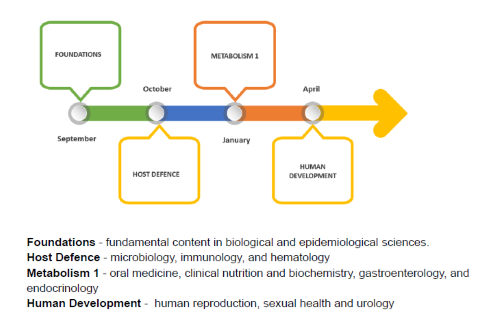
Foundations: Introduces students to fundamentals of biomedical and epidemiologic sciences. The unit examines Biochemistry and Molecular Biology, Anatomy and Histology, Pathology, Pharmacology and Clinical Reasoning and Evidence-Based Practice.
Host Defense: Introduces students to fundamentals of hematology, immunology and microbiology. The unit examines components of blood involved in pathogen defense, the types of pathogens affecting populations locally and globally and the basics of infection and infectious disease.
Metabolism: Introduces students to core concepts in nutrition,
gastroenterology, endocrinology and oral medicine. The unit examines the biochemical role of nutrition, digestive and liver diseases and hormonal regulation of metabolism and growth.
Human Development: Introduces students to the foundations of reproduction, sexuality and urology, supported by anatomy, histology and medical genetics. The unit explores embryology, labor and delivery and the genitourinary system, with introductory material in obstetrics and gynecology linking basic science to clinical care.
MED 2 CURRICULUM
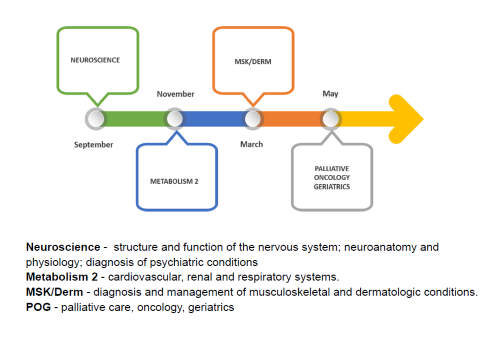
Neuroscience: Introduces students to the structure and function of the nervous system, integrating neuroanatomy, physiology and clinical neuroscience. The unit emphasizes lesion localization, psychiatric diagnosis using a biopsychosocial approach and pharmacologic principles in treating neurologic and psychiatric conditions.
Metabolism II: Introduces students to major diseases of the cardiovascular, renal and respiratory systems. The unit emphasizes pathophysiology and clinical presentation across pediatric and adult populations, with integrated coverage of relevant physiology.
Musculoskeletal & Dermatology: Introduces students to clinical assessment and management of conditions affecting mobility, function and skin health. The unit emphasizes team-based care, occupational and environmental health and the impact of these conditions on daily living and community well-being.
Palliative, Oncology & Geriatrics: POG introduces students to ethical and clinical challenges in caring for frail older adults and patients with cancer. The unit emphasizes interdisciplinary management, end-of-life care and patient and family-centered approaches to decision-making.
MED 1 & 2 LONGITUDINAL CURRICULUM
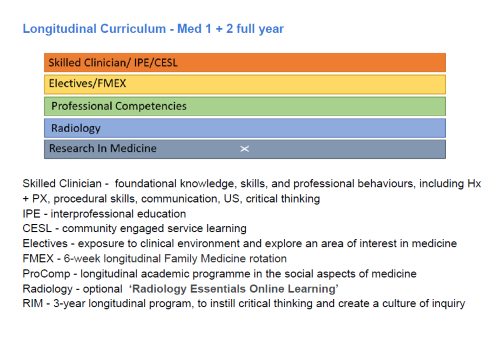
Skilled Clinician Med 1 and Med 2: Students learn to take a history and do a physical exam for the following systems; head and neck, cardiovascular, respirology, neurology, gastroenterology, musculoskeletal, dermatology, ear nose and throat, ophthalmology, psychiatry and pediatrics. By the end of Med 2, they have had a lot of practice writing up a history and physical and are starting to formulate a differential and plan. They also do many procedural skills, including surgical scrub, infection control, iv, injections, ng tube placement, urinary catheter placement, suturing, phlebotomy, and have many sessions training them in point of care ultrasound.
Professional Competencies I: Introduces students to ethics, law, health policy and social determinants of health. The curriculum emphasizes professional skills, equity, patient safety and the ethical dimensions of care within community contexts. These sessions are co-taught with an Allied Health Professional.
Professional Competencies II: The unit expands student knowledge of complex ethical and professional challenges in clinical care. Concepts covered come from population health, epidemiology, ethics, law, informatics, health policy and the humanities. The unit emphasizes equity, ethical reasoning and physician responsibility across diverse care settings.