About Us
From Proteomics to Multi-Omics: Our Evolution with Research
Over the past decades, mass spectrometry has become an essential analytical tool across diverse research fields. From protein identification and quantification to metabolic fingerprinting, this technology has enabled major discoveries by revealing peptide sequences, uncovering post-translational modifications, and identifying clinical biomarkers, among many other breakthroughs. Despite its attractiveness due to its sensitivity, specificity and wide dynamic range of analysis, access to mass spectrometry remains challenging mostly because of the advanced instrumentation, powerful data processing, and specialized expertise it requires.
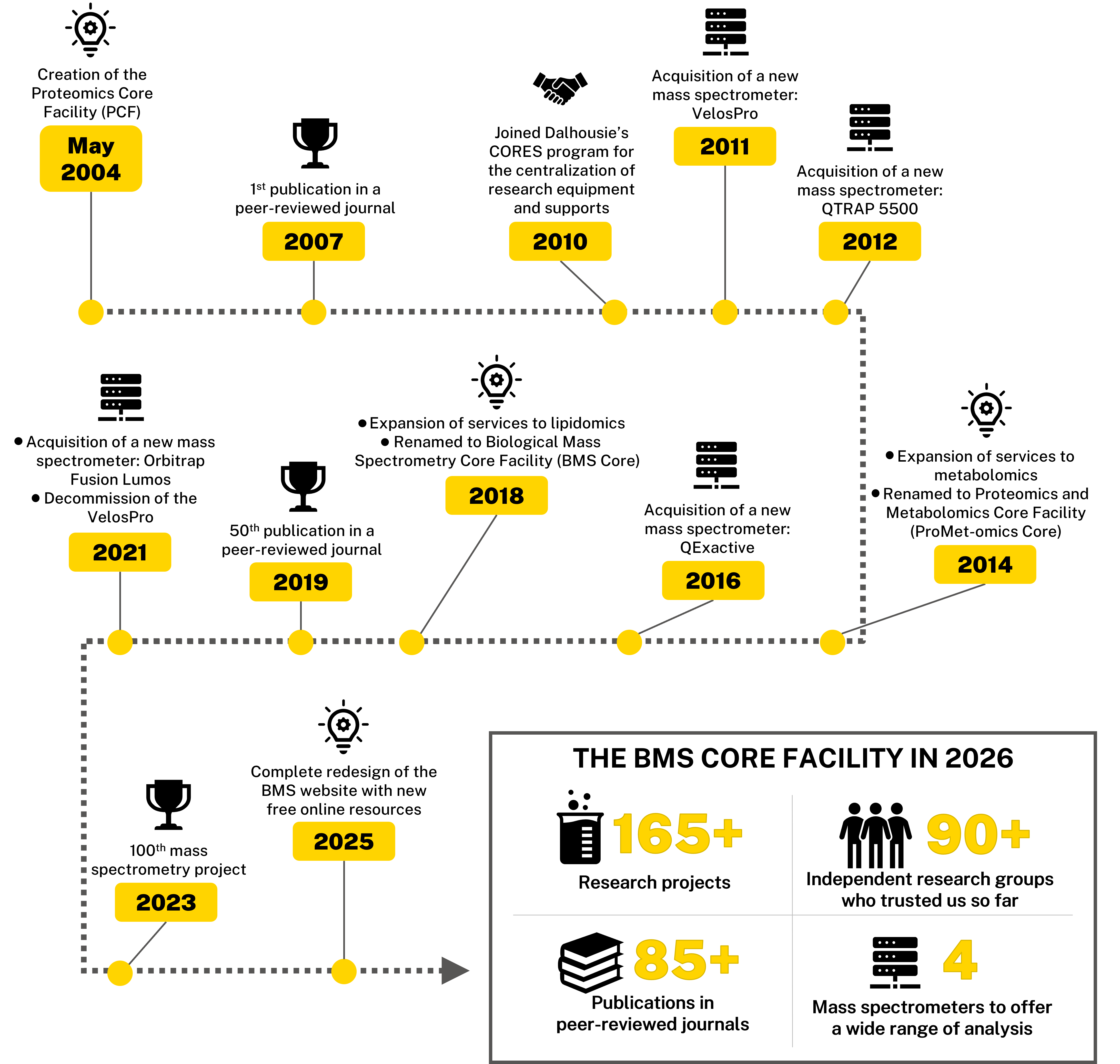
Established in May 2004 within Dalhousie University, the BMS Core Facility was created to bridge this gap. By bringing together advanced instrumentation, dedicated analytical workstations, and a team of experienced specialists, we provide researchers from all backgrounds with the tools and guidance they need to advance their mass spectrometry projects. To further democratize this field, the BMS Core Facility is also committed to sharing knowledge through educational programs within Dalhousie University and freely available online resources.
What began as a dedicated proteomics service has steadily expanded into metabolomics and lipidomics over the years, evolving with the scientific needs of our community. Over its years of service, the BMS Core has proudly supported over 90 independent research groups across Canada, collaborating on both fundamental and clinical research. Today, just as when we began, our team members remain on the lookout for new techniques, and welcome custom projects that push the boundaries of mass spectrometry.
Our history in key dates:
A Collaborative Hub for Cutting-Edge Research
Located in the Life Sciences Research Institute, the BMS Core Facility takes part in Dalhousie University’s CORES (Centralized Operations of Research Equipment and Supports) program. Developed with the support of the Faculty of Medicine, this initiative enhances research excellence and innovation by ensuring fair, equal and timely access to cutting-edge equipment and expert guidance for all researchers. This collaborative network unites specialized core facilities staffed by skilled professionals, helping researchers secure funding, share knowledge, and advance groundbreaking discoveries.
Through the CORES initiative, our team proudly supports Dalhousie researchers and external collaborators by providing a wide range of mass-spectrometry services in proteomics, metabolomics and lipidomics. We offer flexible options, including partial services (data acquisition and analysis) or full support (from sample processing to final results), tailored to meet each project's requirements. Since every study is unique and mass spectrometry can be challenging at times, our team members are always available for personalized one-on-one consultations to guide you every step of the way.
The People Who Make it Happen
Our facility is staffed by skilled, PhD-level researchers who are eager to assist you through every step of your mass spectrometry projects! Meet our current team members:
 Julie Frion - Mass Spectrometry TechnicianFrançais, English
|

Funding and Partnerships
The following funding agencies help the BMS Core facility maintain a high-quality service using state-of-the-art technology: