
Meet researcher, Dr. Samina Abidi
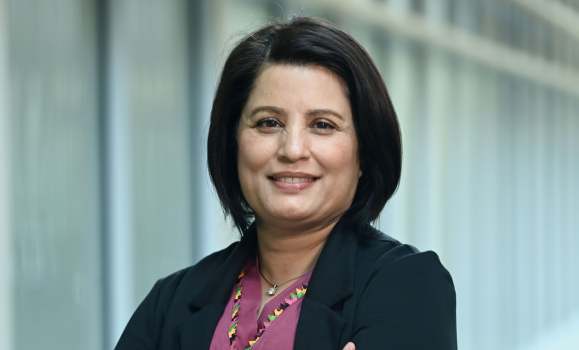
Dr. Samina Abidi is a medical doctor and digital health researcher whose work sits at the crossroads of medicine, computer science, and health information science. As a professor in the Department of Community Health and Epidemiology with a cross‑appointment in the Faculty of Computer Science, she has built an interdisciplinary research program dedicated to transforming healthcare through advanced digital tools. Her work spans clinical decision support, digital therapeutics, chronic disease management, behavior‑change technologies, and AI‑enabled systems, many of which have been implemented and evaluated in real clinical environments. Guided by her commitment to patient care and her passion for innovation, Dr. Abidi creates knowledge‑driven digital solutions that meaningfully improve both provider workflows and patient outcomes.
Q: Can you tell us about the focus of your research?
My research is inherently interdisciplinary, positioned at the intersection of medical informatics, digital health, and health information science. I focus on healthcare knowledge management, clinical decision‑support systems, chronic disease management, comorbid care planning, patient empowerment, behavior‑change interventions, and the evaluation of health information systems. A central part of my work involves developing advanced knowledge‑management approaches using semantic‑web technologies to support clinical decision‑making, enable technology‑assisted care environments, and facilitate personalized behavior change. Through sustained collaboration with clinical partners, I design and implement informatics solutions that address complex, real‑world health‑system challenges, many of which have been deployed and tested in clinical settings.
Q: How is digital health changing care delivery?
Digital health involves the use of digital tools and technologies—such as software, mobile applications, telehealth systems, sensors, wearables, and data analytics—to improve how we deliver, coordinate, and experience care. It is reshaping healthcare by expanding access, strengthening patient engagement, and enabling proactive, data‑driven decision‑making. Digital tools help clinicians provide individualized care, reduce administrative burden, streamline communication, and access real‑time patient data. For patients, digital health supports self‑management, shared decision‑making, and easier access to services, while shifting aspects of chronic disease management into the home.
Q: What inspired you to combine medicine and technology, and how did your journey shape your perspective on patient care?
As a foreign‑trained medical doctor, I have always been guided by a commitment to patient care. My interest in digital health began during my MSc in Information Technology, when I completed a thesis on electronic medical records that revealed the potential for integrating medical knowledge with technological design. This early work demonstrated how digital tools can improve efficiency, effectiveness, and accessibility in healthcare. My transition into health informatics shifted my focus from treating individual illnesses to improving health‑system performance and information structures. This perspective emphasizes prevention, precision medicine, patient‑centred care, and the importance of data‑driven decision‑making.
Q: Can you share examples of digital health systems you’ve developed and how they have supported patient care?
Using semantic‑web methods, my trainees and I have developed intelligent, evidence‑based, personalized systems that support behavior change and chronic disease self‑management. DWISE integrates multiple behavior‑change theories, clinical guidelines, and patient data to help providers personalize diabetes care while empowering patients with self‑management skills. Empower‑BP and the iHeart shared‑decision‑making platform support hypertension management by facilitating structured, patient‑centred consultations. PRISM helps individuals assess their risk for multiple chronic conditions and cancers using knowledge models and visualizations. For clinicians, systems such as IMPACT‑AF and NOAC provide guideline‑based decision support for the management of atrial fibrillation and are used by more than 1,000 physicians in Nova Scotia. COMET further integrates guidelines for atrial fibrillation and chronic heart failure to support comorbidity‑aware decision‑making in primary care.
Q: How do digital therapeutics support patients in managing chronic conditions at home?
Digital therapeutics deliver evidence‑based therapeutic interventions directly in a patient’s home environment. They are particularly valuable for chronic disease management, where multimorbidity, polypharmacy, and modifiable risk factors must be addressed. Using mobile applications, sensors, wearables and data analytics, digital therapeutics offer continuous monitoring, early detection of symptom changes, personalized recommendations, and guidance for medication adherence and behavior change. These tools enhance patient engagement, support shared decision‑making, and provide healthcare providers with deeper insight into each patient’s condition.

Q: Why is collaboration essential in digital health?
Digital health requires collaboration among clinicians, computer scientists, health organizations, and patients. Clinicians contribute essential medical expertise and contextual understanding of patient needs and workflows. Patients help ensure that tools are usable, relevant, and sensitive to real‑world barriers. Computer scientists bring the technical knowledge necessary to design flexible, secure, and interoperable systems. Health organizations ensure that solutions align with infrastructure, priorities, and implementation requirements. As a health informatician, I act as a knowledge engineer, integrating diverse types of knowledge, defining problems clearly, and guiding system design and evaluation. Collaboration ensures digital innovations are both scientifically sound and practically impactful.
Q: How is AI transforming healthcare?
AI is improving many aspects of care, from predictive analytics and early risk detection to advanced imaging diagnostics and optimized clinical workflows. Machine learning models analyze complex combinations of clinical and lifestyle data to support proactive interventions. Medical digital twins integrate multimodal data to simulate disease progression and treatment outcomes for individual patients. Large Language Models help process extensive textual information, reduce documentation burden, enhance communication, and support patient education. Overall, AI is enabling more personalized, efficient, and accurate care.
Q: What do you enjoy most about teaching and mentoring in health informatics?
Teaching in health informatics brings together students from a wide range of backgrounds, cultures, and academic paths. This diversity makes the classroom dynamic and intellectually rich. I enjoy hearing students’ varied perspectives and problem‑solving approaches and incorporating real‑world examples from my research into coursework. As co‑director of NICHE (kNowledge Intensive Computing for Healthcare Enterprises) research group in the Faculty of Computer Science, I mentor students as they collaborate on interdisciplinary AI and digital health projects, encouraging skill‑sharing and teamwork while helping them connect theoretical concepts with applied innovation.
Q: What advice would you give to someone interested in the intersection of health and technology?
Digital health requires more than technical skills. It relies on understanding health information science, system management, digital equity, AI accountability, and ethics. Because digital health is highly interdisciplinary, it demands strong interpersonal skills and the ability to navigate differing professional cultures. Effective knowledge‑engineering is crucial; it involves observing workflows, listening to end‑users, translating needs into system requirements, and communicating clearly about what technology can realistically achieve.
Q: What changes would you like to see in Canada’s use of technology in healthcare, and how do you see digital health shaping the future?
Canada must strategically leverage digital technologies, such as predictive analytics, telemedicine, and remote monitoring, to improve access, quality, and chronic‑disease management, especially for rural and remote communities. Major barriers remain, including making different systems work well together, regulation, privacy, and digital equity. Looking ahead, digital health will continue driving a shift from institution‑centred, episodic care toward patient‑centred, personalized, proactive healthcare. As patients gain access to meaningful, actionable data, healthcare will become more collaborative, with providers serving not only as clinicians but also as guides and mentors empowered by digital tools.