
Meet postdoctoral fellow, Dr. Ash Porter
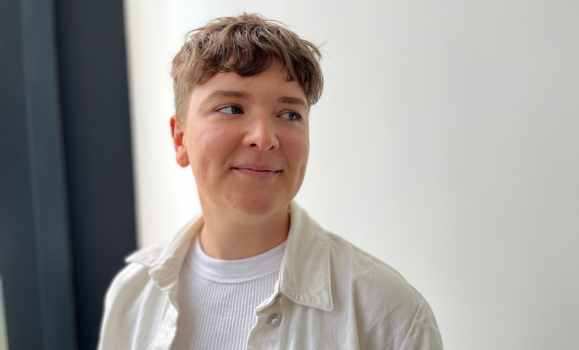
For Dr. Ash Porter, studying the future of infectious disease sometimes begins by looking into the past.
A postdoctoral fellow in the Faculty of Computer Science working with Dr. Finlay Maguire, associate professor in Dalhousie’s Faculty of Computer Science and cross-appointed in the Department of Community Health and Epidemiology, Dr. Porter studies viral phylodynamics and the emergence of zoonotic viruses, infectious illnesses that spread between animals and humans, from wildlife reservoirs. In simple terms, phylodynamics looks at how viruses spread, adapt and change over time. Their research brings together these approaches with large-scale genomic data and museomics, the study of genetic material preserved in museum specimens.
Dr. Porter completed a Bachelor of Science in genetics and an honours thesis at the University of Queensland before earning a PhD at the University of Sydney. During their PhD, Dr. Porter studied how viruses evolve and adapt over time, using genetic clues from both modern and historical samples to better understand where viruses come from and how they change (metatransciptonomics). They later joined the Microbial Diagnostic Unit Public Health Laboratory at the Doherty Institute, part of the University of Melbourne, where they contributed to research on the phylodynamics of SARS-CoV-2.
Their subsequent work has included a CSIRO Early Research Career (CERC) Postdoctoral Fellowship at the Australian National Wildlife Collection and a 2025/2026 Fulbright Postdoctoral Fellowship focused on using historical wildlife specimens to better understand zoonotic disease. Now, Dr. Porter is investigating the diversity and evolution of coronaviruses circulating among North American wildlife.
What led you to study viral evolution and zoonotic disease?
I have always been drawn to research questions that bring together viral and host biology, virus-host interactions and molecular evolution. My training has included both wet-lab and dry-lab research, which has given me a broad perspective and the ability to approach these questions using multiple methods.
Opportunities to train in ancient and historical DNA, as well as phylodynamics, have been particularly influential. They shaped my interest in exploring how viruses evolve and how studying their histories can help us understand the diversity we see today.
How does your research use museum collections to deepen our understanding of viruses?
I’m interested in increasing our knowledge of wildlife viruses by making use of existing resources. That can include mining public data repositories, but it can also mean working with museums to sample wildlife specimens collected across different species, locations and periods.
My research combines phylogenetics, phylodynamics and large-scale genomics with museomics. Museum specimens can provide a valuable historical record, allowing us to expand the period over which we study viruses and investigate lineages that might otherwise be missed by contemporary surveillance.
One example is my research using metatranscriptomics to study formalin-fixed and ethanol-preserved wildlife specimens. Through that work, my colleagues and I identified novel and divergent rotavirus strains in Australian bats, including lineages from specimens collected in the 1960s and 1990s. These findings substantially increased our knowledge of the virus’s range across time and place in Australian wildlife.
How has your research contributed to public health responses?
From 2020 to 2023, I worked with Dr. Sebastian Duchene and the Doherty Institute’s Microbial Diagnostic Unit Public Health Laboratory as part of the broader genomic epidemiology response to the COVID-19 pandemic. My work focused on viral phylodynamics and understanding how SARS-CoV-2 was evolving, including the emergence of variants of concern.
I believe it is important for research to connect with decision-making. I collaborate with policymakers and organizations so that findings can help inform public health and related responses. I have contributed to three reports for government agencies in Australia concerning SARS-CoV-2, avian influenza and a novel Hantaviridae lineage.
What role has mentorship played in your career?
I’m immensely grateful to the mentors who have helped me navigate my career, particularly during my PhD and postdoctoral research. Over the past two years, I have had several mentors outside my research group, and some outside my field, who have been essential in helping me make decisions about my research and long-term career.
Having mentors with different areas of expertise has exposed me to a range of perspectives. Their guidance has also helped me navigate the challenges and opportunities that arise throughout a research career.
How do you help foster a more inclusive research environment?
As an openly queer and transgender scientist, I have served on several equity and diversity committees advocating for greater inclusion of researchers with diverse identities and backgrounds in STEM. I’ve also been awarded funding to organize events to raise awareness and promote welcoming of transgender students and researchers in academia, along with speaking at a range of events held by universities, schools and public events.
What impact do you hope your work will have?
My long-term goal is to expand zoonotic surveillance across a wider range of species, places and periods. Through novel virus discovery in wildlife and phylogenetic and phylodynamic reconstruction, I hope to increase our understanding of where zoonotic lineages originate and how they evolve.
Viruses emerging in new hosts are a major concern for human, animal and environmental health. Increasing our knowledge of the vast diversity of viruses circulating in wildlife, and understanding how those lineages evolve and adapt to new hosts, is critical to understanding the spillover events that can lead to outbreaks and pandemics.