
Research where it matters most
» Go to news mainUncovering the hidden biology of women’s health

For decades, scientists have known that the trillions of bacteria living in and on our bodies play a critical role in health. But when it comes to the female genital tract, many of the most basic questions remain unanswered.
Which microbes protect health? Which contribute to disease? And how do they influence outcomes as serious as infection, cancer, and preterm birth?
When Dr. Karen Lithgow, assistant professor in the Department of Microbiology and Immunology at Dalhousie, first arrived at Dalhousie University last spring, she brought with her a research focus that is both scientifically complex and historically overlooked: the vaginal microbiome.
She now leads a team investigating the bacteria that reside within the female genital tract, with a particular focus on how these bacteria interact with human cells to trigger pregnancy complications and increase susceptibility to sexually transmitted infections.
“There are questions that directly affect women’s lives,” Dr. Lithgow says. “Yet they’re questions we’re only just beginning to answer.”
Understanding an invisible ecosystem
At the heart of Dr. Lithgow’s research is a deceptively simple idea: balance matters. A healthy vaginal microbiome is typically dominated by beneficial bacteria that help protect against infection. When that balance is disrupted, it can lead to a condition called bacterial vaginosis (BV).
BV is incredibly common. Roughly one in four women between the ages of 15 and 45 are affected at any given time, and most women will experience it at least once in their lives. It is the most common cause of vaginal symptoms in people of reproductive age in Canada, often presenting as abnormal discharge, odor, irritation, or pain. But the consequences go far beyond discomfort.
“BV acts like a risk multiplier,” Dr. Lithgow explains. “It increases the risk for genital tract cancers, sexually transmitted infections, infertility, pelvic inflammatory disease, and pregnancy complications like preterm birth.”
How the Lithgow Lab studies the problem
Studying the vaginal microbiome presents challenges unlike almost any other area of microbiology. There is no reliable animal model, meaning researchers can’t rely on the tools commonly used to study disease.
Instead, the Lithgow Lab uses anaerobic microbiology, in vitro systems to model the vaginal and cervical tissues of the female genital tract and study proteins and genomes to examine how bacteria interact with human cells, and how those interactions either confer protection or cause damage and disease.
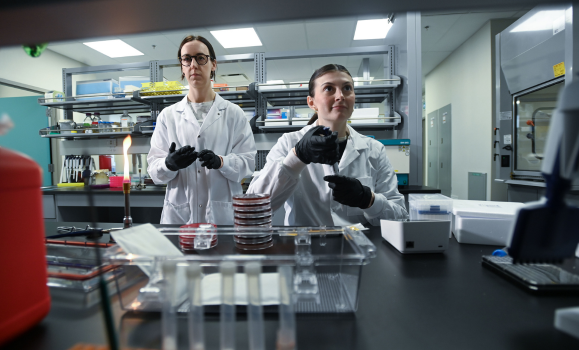
Many of the bacteria involved are difficult to grow and manipulate and require oxygen‑free environments and specialized equipment, making the work technically demanding and expensive. Training researchers to generate consistent, reliable data can take months.
And then there’s the biology itself.
“The vaginal microbiome is constantly changing,” Dr. Lithgow says. “Hormones, menstrual cycles, sexual activity, contraception, menstrual products—all these factors influence it. Trying to model that complexity in the lab is incredibly challenging, but it’s also why this work is so important.”
From microbes to motherhood
One of the most promising, and urgent, areas of research in the Lithgow Lab focuses on preterm birth, a leading cause of infant illness and death worldwide.
In Canada, 8.3 per cent of babies are now born preterm—the highest rate recorded in more than 50 years. While survival rates have improved, babies born early face higher risks of hospitalization, long‑term health complications, and developmental challenges.
Rather than focusing solely on the presence of harmful bacteria, the Lithgow Lab examines what these bacteria are actually doing inside the female genital tract.
Her team studies how BV‑associated bacteria secrete proteases—enzymes that can break down human tissues. These bacterial proteases appear to mimic the body’s own biological processes that initiate labour, potentially weakening pregnancy tissues and triggering contractions prematurely.
“If bacteria are essentially hijacking natural labour pathways,” Dr. Lithgow explains, “that opens up entirely new possibilities to detect and prevent these damaging activities.”
By targeting specific bacterial activities, rather than broadly eliminating bacteria with antibiotics, this research points toward more precise, biologically informed interventions.
Beyond the lab: changing care and culture
Dr. Lithgow believes her research has implications far beyond drug development. Improving how clinicians and patients understand vaginal health is a critical first step.
“Many clinical guidelines are outdated, and training around the vaginal microbiome hasn’t kept pace with the science,” she says. “There’s a real opportunity to improve literacy for both patients and for healthcare providers.”
This gap has real‑world consequences. Sexually transmitted infections are rising across Canada, including syphilis, which has surged after decades of decline. In 2022 alone, nearly 14,000 cases of infectious syphilis were reported nationally, including congenital infections passed from mother to infant.
“There’s a reason we’re seeing these patterns,” Dr. Lithgow says. “Historically, we’ve relied on male‑based research models and one‑size‑fits‑all interventions that don’t reflect the unique biology of the female genital tract.”
There’s also a deeper issue at play: stigma.
“Topics like menstruation, vaginal discharge, and sexual health are still taboo,” Dr. Lithgow says. “And often, the areas we’re most uncomfortable talking about are the areas where research investment has lagged, even though the potential for improving health outcomes is enormous.”
A moment of opportunity
The vaginal microbiome field has reached a turning point. Researchers now have decades of data identifying which microbial communities are linked to health and disease. The next step—understanding how those microbes function at a molecular level—is where translation to clinical care becomes possible.
The Lithgow Lab is positioned squarely in this space, using mechanistic, translational research to bridge the gap between discovery and patient impact.
Some of this vital work is already supported through national and international research grants. Other areas, including their pregnancy and preterm birth projects, are still seeking funding. Support from donors can accelerate progress by enabling specialized equipment, training highly skilled researchers, and sustaining essential clinical partnerships.
“This is research that doesn’t just advance science,” Dr. Lithgow says. “It has the potential to change lives.”
Recent News
- Teddy Bear Clinics help take the fear out of healthcare
- Dr. Shawna O'Hearn advances menopause workplace support
- As he assumes leadership of Dalhousie’s Faculty of Medicine, Dr. Razack discusses his vision for the future, his leadership philosophy, and the Faculty’s role in improving health across the Maritimes.
- Canadian study published in NEJM could change care after joint replacement surgery
- Research exchange builds new pathways for collaboration
- Dalhousie medical student recognized among Canada's future health leaders
- New Dal Med initiative empowers youth with life‑saving skills
- Realistic simulations prepare learners for complex care