Ready, Set, Respond
» Go to news mainNew Dal Med initiative empowers youth with life‑saving skills

Knowing what to do in the moments before professional help arrives can make all the difference during a medical emergency.
That's the idea behind Ready, Set, Respond (RSR), a new student-led outreach program recently launched at Dalhousie Medicine by second year medical student and Dal alumnus, Ernest Ng.
Part of a growing national network with chapters at medical schools across Canada, the initiative teaches youth how to recognize and respond to medical emergencies through hands-on learning experiences focused on CPR, automated external defibrillators (AEDs), stroke recognition, seizure response, and overdose awareness.
For Ernest, the program brings together two of his long-standing interests: emergency medicine and community outreach.
Drawn to the fast-paced, ever-changing nature of emergency medicine, Ernest has spent years volunteering in STEM outreach programs and educating young people about science and health. When he arrived at Dal Med, he was surprised to find there wasn't a similar medical outreach program already in place.
"I looked over their mandate and their goals and vision," he says of the national Ready, Set, Respond organization. "It was perfect for what I was hoping to achieve here at Dal."
After connecting with the national team, Ernest and fellow Dal med student, third-year Kate McKesey, established Dalhousie's chapter earlier this year, making it the 10th medical school in Canada to join the initiative.
The chapter's first community session took place July 7 as part of the PLANS Prep Institute (PPI), a Dalhousie summer camp program that introduces African Nova Scotian high school students to health professions and post-secondary pathways.
“Adding the Ready, Set, Respond session to this year’s PLANS Prep Institute gave campers a unique opportunity to learn practical life-saving skills,” shared Said Msabaha, Manager of PLANS.
Life-saving knowledge for everyone
One of the central ideas behind RSR is that emergency situations can happen anywhere, to anyone.
“We run sessions on health events like strokes, seizures, overdose responses, as well as awareness around CPR and AEDs,” says Ernest. “Our focus is on education and preparedness.”
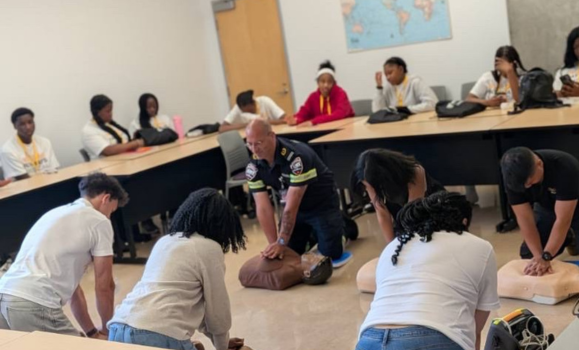
While the program does not provide formal first aid or CPR certification, it aims to equip participants with practical, potentially life-saving knowledge and the confidence to use it.
“Our goal is simple: if an emergency happens, we want young people to feel more prepared to recognize what’s happening and take action until professional help arrives,” he says.
Building confidence and futures
For many students, careers in medicine can seem distant or unattainable, especially those from communities that have faced systemic barriers to health and education opportunities. Through interactions with medical student volunteers, RSR seeks to break down those barriers.
“I want these young people to be able to see themselves in the volunteers and imagine themselves as future health-care professionals,” says Ernest.
“I want them to think, ‘Maybe I could be a doctor someday,’ and know the answer is ‘damn right, you can.’ If students never see themselves represented in health care or get meaningful exposure to it, those opportunities can feel out of reach before they've even had a fair chance.”
Partnerships that make a difference
Launching a new outreach initiative takes collaboration. Ernest credits the PLANS team with helping create a strong foundation for the local chapter's first year.
“RSR is a great fit with the PPI program,” says Said. “Beyond exposing participants to careers in paramedicine, the hands-on experience builds confidence, increases health literacy, and equips young people with skills that could one day help them respond in an emergency and potentially save a life,”
The July 7 session was co-facilitated by Ernest, Kate, and Mike Janczyszyn, AED Registry Program Coordinator with Emergency Health Services (EHS), whose work includes supporting CPR and AED education initiatives across the province.
“The collaboration piece is really huge,” says Ernest. “As medical students, we can bring the energy and the time, but partnerships with wonderful professionals like Mike and the team at EHS bring a wealth of knowledge and experience.”
The 20 participants in attendance also had the opportunity to learn from Doug Allen, EHS's Paramedic Recruiter, who spoke about careers in paramedicine and pathways into the profession.
“The strongest version of this program is one that's built alongside schools, teachers, community organizations, and local leaders,” says Ernest. “Not just delivering content, but asking them, ‘What do you need from us?’”
Looking ahead
Although the chapter is only a few months old, Ernest hopes it will continue to grow long after he graduates, expanding beyond Halifax to communities across Nova Scotia, New Brunswick, and Cape Breton.
For now, his focus is on helping participants leave sessions feeling more prepared than when they arrived.
“To me, outreach is not separate from medical education,” he says. “It's part of learning what it means to be useful to the community around you.”
Recent News
- As he assumes leadership of Dalhousie’s Faculty of Medicine, Dr. Razack discusses his vision for the future, his leadership philosophy, and the Faculty’s role in improving health across the Maritimes.
- Canadian study published in NEJM could change care after joint replacement surgery
- Research exchange builds new pathways for collaboration
- Dalhousie medical student recognized among Canada's future health leaders
- New Dal Med initiative empowers youth with life‑saving skills
- Realistic simulations prepare learners for complex care
- Shaping the systems that train Canada’s physicians
- Advancing Indigenous leadership in health care