News
» Go to news mainDr. Patrick Fok named inaugural Dr. Ron Stewart Clinician Scientist in EMS

Few people have shaped emergency medicine and paramedicine as profoundly as Dr. Ron Stewart.
Through a career defined by innovation, leadership, and a deep commitment to patient‑centred care, he helped lay the foundation for the emergency systems in place today— work that would go on to save countless lives.
From serving as the first medical director of the Los Angeles paramedic program, to founding the Department of Emergency Medicine at the University of Pittsburgh, and to establishing Nova Scotia’s Emergency Health Services as Minister of Health in the 1990s, Dr. Stewart’s career was defined by a conviction that emergency care must evolve alongside the needs of society. He championed evidence‑based practice, professional identity for paramedics, and a system‑level understanding of how out‑of‑hospital care shapes patient outcomes.
Dr. Stewart, who sadly passed away in October 2024, believed deeply in paramedics, not just as clinicians, but as people. He cared about their training, their role in research, and their wellness.
That vision continues to shape emergency medicine today.
As the inaugural Dr. Ron Stewart Clinician Scientist in Emergency Medical Services (EMS), Dr. Patrick Fok is working in the space Dr. Stewart helped create. In this position, which began April 1, 2026, he will advance pre‑hospital research and empower paramedics as both researchers and professionals, thereby strengthening the links between emergency medical systems, improving patient outcomes, and enhancing communities they serve.
Created through the vision and a generous donation to Dalhousie University from Dr. Stewart made in his lifetime, with additional support from the Department of Emergency Medicine and the QEII Foundation, the role celebrates Dr. Stewart’s legacy as a pioneer of modern paramedicine and a former leader in emergency medicine, health policy, and public service in Nova Scotia.
It is a role Dr. Fok is deeply honoured to hold.
"Dr. Ron Stewart wanted paramedics to help shape their field of EMS and improve care for the patients they serve,” he says. “This role reflects that vision—supporting paramedics and other researchers who want to conduct high-quality EMS research with a focus on patient-centered outcomes.”
Drawn to the moments that matter
Dr. Fok was first exposed to emergency medicine by his mentor, Dr. Robert Primavesi, during his medical school training at McGill University.
“I was drawn to the high-acuity, the undifferentiated presentations, and the need for rapid decision-making,” recalls Dr. Fok.
He had also long been interested in out-of-hospital medicine. A licensed pilot and self-proclaimed ‘aviation geek,’ his interest in aviation and emergency medicine made pre-hospital medicine a natural fit.
That interest grew over time, and Dr. Fok deliberately sought opportunities to focus on pre‑hospital medicine, structuring his residency to include multiple pre‑hospital electives, such as tactical medicine with the St. Charles County SWAT team in Missouri, transport medicine with STARS in Calgary, and international medical evacuation with SkyService in Montreal. Along the way, he worked with motorsport medical response teams at the Formula One Grand Prix of Canada and medical teams with the Ironman at Mont-Tremblant, QC. Later, he travelled to Australia to train in Pre-Hospital and Retrieval Medicine (PHARM) with the MedSTAR Emergency Medical Retrieval Services, where he treated and transported critically ill patients in helicopters, planes, and rapid‑response vehicles as a member of critical care transport teams.
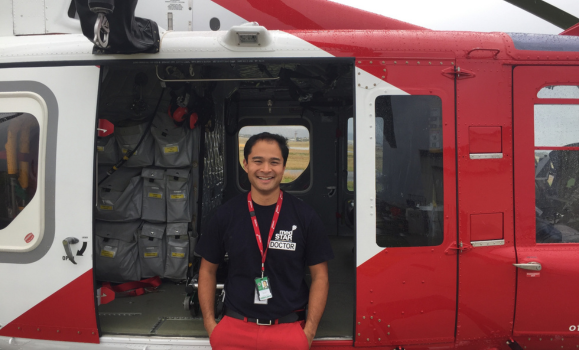
Today, Dr. Fok’s clinical work spans the full continuum of emergency medical care. Working as a Medical Control Communications Physician with Emergency Health Services (EHS), he provides medical support to paramedics and helps guide out-of-hospital care decisions. As a Medical Control Physician with EHS LifeFlight, he makes transport decisions and provides medical oversight and advice to critical care transport teams that transport critically ill patients throughout Nova Scotia. And at the Halifax Infirmary, he treats patients in the emergency department.
“Emergency medicine and pre‑hospital care requires an understanding of the entire patient journey—from the 911 call to definitive care or discharge,” he says. “Seeing patients at every stage gives me a much better understanding of where they come from and what they need.”
He says this knowledge also highlights the importance of balancing patient needs with system resources.
Making better decisions, earlier
Dr. Fok’s involvement with Canadian COVID-19 Emergency Department Rapid Response Network (CCEDRRN) and the Canadian Emergency Department Research Network (CEDRN) as a member of the executive committee has shaped his systems‑level view of emergency medicine.
His current work focuses on medically complex and vulnerable patients, with a goal to ensure the right patient gets the right care, at the right time, with the right resources.
From examining how to identify hemodialysis patients who may require urgent dialysis, to studying the transfer of stroke patients for endovascular thrombectomy (EVT), Dr. Fok’s work asks a consistent question: how can emergency systems make better decisions earlier, so patients benefit and unneeded transfers are avoided?
“Transport to tertiary care centers can be costly and disruptive, especially for patients who may be transported hours away from their home community,” says Dr. Fok. “If we can identify earlier which patients will benefit from this transport, we can improve care for everyone.”
Building the future of EMS science
Alongside his own research, as the Dr. Ron Stewart Clinician Scientist in EMS, Dr. Fok will support paramedics who are interested in research through graduate training and encourage students from other disciplines, such as engineering, data science, or health economics, apply their expertise to EMS science. Mentorship, he says, is essential to growing the next generation of EMS researchers.
“And it’s not just mentorship; it’s stewardship. It’s opening doors, making connections, and creating opportunities for trainees so they can succeed and advance EMS sciences.”
Dr. Fok hopes his work will help improve how emergency systems support both patients and providers. Central to that vision are better decision‑support tools for paramedics, optimizing use of limited resources, and ultimately, improved patient outcomes. To be successful, he says, we need to leverage collaboration that includes clinicians, paramedics, engineers, data scientists, health economists, and, perhaps most critically, patients to promote the growth of EMS science.
“Emergency medicine and EMS research are team sports. We need to make sure we’re answering questions that matter to patients, not just system‑level outcomes. Improving emergency care means reaching beyond medicine and working together toward better outcomes for the populations we serve.”
There’s something meaningful about being able to make a real difference during someone’s worst moments.
At its core, Dr. Fok says, emergency medicine is about showing up when people need help most.
“Most emergency providers—paramedics, nurses, physicians—are drawn to helping patients who are acutely ill,” he says. “These are patients who are unwell, often at their most vulnerable, and need help immediately. There’s something meaningful about being able to make a real difference during someone’s worst moments.”
And now, like Dr. Stewart, who made a difference for so many, Dr. Fok carries that legacy forward—made possible by Dr. Stewart’s generosity and his belief in investing in people and ideas that change lives.
Recent News
- Popular workout supplement may blunt heart benefits of exercise in females, Dalhousie study finds
- Dr. Giacomo Vivanti named Joan and Jack Craig Chair in Autism Research at Dalhousie
- Introducing Dalhousie's honorary degree recipients for Spring Convocation 2026
- Dalhousie researchers secure major funding through Research Nova Scotia competition
- Dr. Patrick Fok named inaugural Dr. Ron Stewart Clinician Scientist in EMS
- A breakthrough in treating Fabry disease
- Meet the 2026 Board of Governors Award winners
- DalSolutions: Equipping communities with research skills to improve their lives